

Picture three card tables, each running at its own pace. At one, a Teen Patti hand is decided in a flurry of bets; at another, an Andar Bahar round hangs on the turn of a single matching card; at a third, a Rummy player quietly rearranges a hand that has been building for several turns. Casino Khajana lists Teen Patti, Andar Bahar and Rummy among its card-game offerings, and each one asks for a different kind of attention.
Three games, three tempos
Teen Patti moves in short bursts. A hand can be over in a few betting rounds, and the pressure to act quickly is part of the experience. Andar Bahar is even more compressed: the dealer turns cards until one matches the centre card, and the whole round can finish in under a minute. Rummy stretches out. A single hand may take several minutes, and the game rewards patience, memory and a willingness to change plans as the discard pile grows.
These tempos suit different moods. If you want quick decisions and a bit of psychology, Teen Patti fits. If you prefer a simple binary choice with a short suspenseful wait, Andar Bahar is the one. If you enjoy planning and hand management, Rummy gives you plenty to think about across a longer round. None of these games is inherently better; they simply ask for different things.
Teen Patti: three cards and a decision
Teen Patti is played with three cards per player. The standard ranking runs from trail (three of a kind) at the top, through pure sequence (three consecutive cards of the same suit), sequence (three consecutive cards of mixed suits), colour (three cards of the same suit that are not consecutive), pair, and high card. Within each category, the highest card decides; a trail of aces beats a trail of kings. Suits generally do not have a strength order, but they matter for forming a pure sequence or a colour.
The game comes in two broad forms. In player-versus-player Teen Patti, you bet against other players and can choose to play blind (without seeing your cards) or seen (after looking). Blind play usually requires a lower stake but carries more uncertainty; seen play costs more but gives you information. The decision to fold, call or raise is the heart of the game. In casino dealer variants, you may be playing against the dealer or a paytable, and the rules can differ. At Casino Khajana, the specific table rules govern the available variant, so read the table description before you join.
Teen Patti is not a game of perfect information. Reading betting patterns, managing your stack and knowing when to release a seen hand that looks tempting but is likely beaten are all part of the skill. The blind option adds a psychological layer: a blind player can apply pressure without revealing strength, while a seen player must decide whether the extra information is worth the higher stake.
Andar Bahar: the matching card
Andar Bahar starts with a designated card placed face up in the centre. Players bet on whether the next card of the same rank will appear on the Andar (inside) side or the Bahar (outside) side. The dealer then turns cards alternately, and the first side to produce a matching rank wins. The core bet is binary, which makes the game easy to follow, but the payout odds for each side reflect the probabilities at that moment.
Some versions offer side bets on the exact card or on how many cards will be dealt before a match, but these vary by table. The cards are dealt without replacement, so the odds shift as cards are revealed; a run of results on one side is not a predictive system for the next round. Bankroll discipline matters because the game moves quickly and it is easy to place several bets in a short time.
What makes Andar Bahar engaging is the shared anticipation of each card turn. In a live dealer setting, the reveal is a small event, and the table reacts together. It is a game of chance with a social wrapper, and that is part of its appeal.
Rummy: sequences, sets and the long game
Rummy is the strategist’s card game. The goal is to arrange your hand into valid combinations: sequences (three or more consecutive cards of the same suit) and sets (three or four cards of the same rank, usually in different suits). A pure sequence contains no joker; an impure sequence uses a joker. In the common 13-card Indian Rummy format, at least two sequences are required, and one of them must be pure. The exact rules can vary, so the table rules at Casino Khajana govern the variant you play.
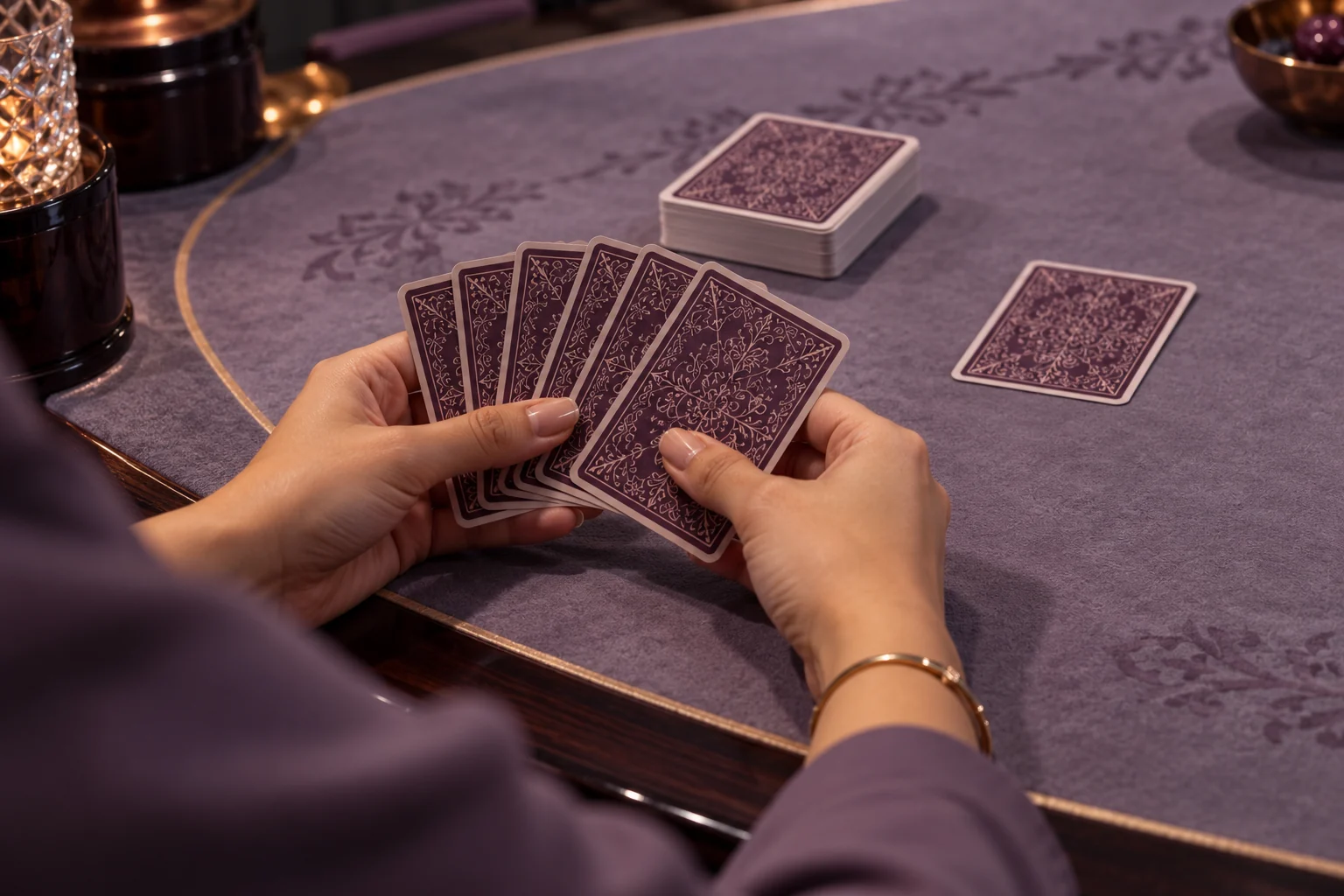
Decision-making in Rummy is continuous. On each turn, you draw a card from the closed deck or the open discard pile, then discard one. The choice of which card to pick and which to let go is the heart of the game. You are constantly weighing the probability of completing a sequence or set, the risk of holding a high-value card that opponents might need, and the information revealed by discards. Unlike Teen Patti, there is no hidden betting round; the tension is in hand management.
Rummy rewards memory and observation. Tracking which cards have been discarded helps you infer what opponents might be collecting. It also rewards flexibility: a hand that looks promising can become a liability if the needed cards do not appear. For example, holding the 5 and 6 of the same suit gives you an open-ended sequence candidate waiting for a 4 or a 7, but if those cards keep passing you by, that plan may need to change. The game is slower than Teen Patti or Andar Bahar, and it keeps your mind busy for longer.
Suits, ranks and why they matter
All three games are built on the standard 52-card pack of four suits and thirteen ranks, but they treat suits and ranks differently. In Teen Patti, rank determines the strength of a hand, while suits matter for pure sequences and colours but generally do not carry a strength order. In Andar Bahar, only rank matters for the match; suits are irrelevant. In Rummy, suits are central to sequences, and ranks determine sets. Rummy is often played with more than one deck and with jokers, so the composition can differ from a single 52-card pack.
These differences shape decisions. In Teen Patti, a pair of kings is strong, but a pair of kings with a low kicker can be beaten by a pair of aces with any kicker. In Rummy, three kings already form a valid set, so a fourth is a bonus rather than a requirement, and the value of holding it depends on what else your hand needs. In Andar Bahar, the rank of the centre card is the only thing that matters, and the suit is irrelevant. Understanding these distinctions is part of learning to read each game on its own terms.
Pace and psychology at the table
Teen Patti is a game of bursts. The betting rounds are short, and the pressure to act quickly can lead to impulsive decisions. Skilled players slow themselves down, especially when holding a seen hand. Andar Bahar is even faster; the entire round can be over in less than a minute. Rummy, by contrast, is a marathon. A single hand can take several minutes, and the game rewards patience over impulse.
Psychologically, Teen Patti invites bluffing and reading opponents. Andar Bahar invites superstition and pattern-seeking, even though each card turn is not independent of the cards already dealt. Rummy invites planning and adaptation. Recognising which mindset you are in can help you choose the right game for your mood and your bankroll.
Bankroll and table limits
Teen Patti, Andar Bahar and Rummy each set their own stake ranges and charges, which can differ by table and variant. Some versions use fixed limits, while others allow players to choose amounts within a range. Before joining a hand, read the specific rules for that table so you know the minimum and maximum stakes and any fees that apply.
Because these are casino games, the house has an edge in casino-banked formats. Player-versus-player games may involve a commission or charge according to the table rules. No betting system can overcome the built-in advantage in the long run. Treat the games as entertainment, not as a source of income.
Playing at Casino Khajana
Casino Khajana lists Teen Patti, Andar Bahar and Rummy alongside slots, live casino and cricket, according to the brand’s published description. That description also notes deposits via UPI or Paytm, balances held in INR and 24×7 support. The casino is for adults aged 18 and over, and terms and conditions apply. If you are new to the platform, the live casino tables article explains how live dealer games work, and the slots article covers the reels if you want a break from cards. More articles are available in the Casino Khajana articles section.
These card games are intended for adults. Gambling involves risk, including the loss of money. Play responsibly and within your means.